By Website | 29 September 2021 | 1 Comments
The principle and application of photocatalyst
Photocatalyst refers to a general term for photo-semiconductor materials with photocatalytic function represented by nano-sized titanium dioxide.
The photocatalyst is coated on the surface of the substrate, and under the action of ultraviolet light and visible light, it produces a strong catalytic degradation function: it can effectively degrade toxic and harmful gases in the air; it can effectively kill a variety of bacteria, and can release bacteria or fungi Toxin decomposition and harmless treatment; at the same time, it also has the functions of formaldehyde removal, deodorization, anti-pollution, and air purification. In other words, under the irradiation of light, the photocatalyst will produce a photocatalytic reaction similar to photosynthesis. It has a strong photo-redox function, which can destroy the cell membrane of bacteria and solidify the protein of the virus, causing the bacteria to lose and die, and at the same time, it can the harmful compounds released by the cell corpses are decomposed into harmless water and carbon dioxide. PURETi titanium clean U.S. FDA food inspection center certification.
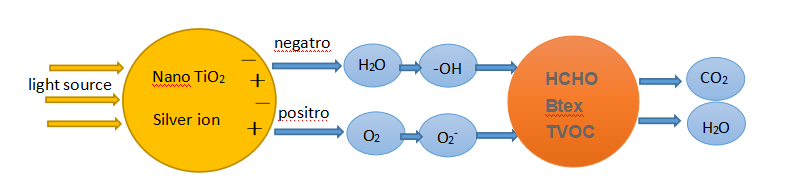
Photocatalyst materials mainly include nano-TiO₂, ZnO, CdS, WO₃, Fe2O₃, PbS, SnO2, ZnS, SrTiO₃, SiO₂, etc. Since 2000, some nano-precious metals (platinum, rhodium, palladium, etc.) have been found to have better photocatalytic performance. However, since most of them are prone to chemical or photochemical corrosion, and the cost of precious metals is too high, they are not suitable as photocatalysts for household air purification.
Its main functions are:
1.Air purification function: Purify formaldehyde, benzene, ammonia, sulfur dioxide, carbon monoxide, nitrogen oxides and other harmful organic substances that affect human health.
2. Sterilization function: It has bactericidal effect on Escherichia coli, Staphylococcus aureus, etc. While sterilizing, it can also decompose harmful compounds released from the dead bacteria.
3. Deodorizing function: Deodorizing effect on cigarette odor, toilet odor, garbage odor, animal odor, etc.
4. Anti-fouling function: prevent oil, dust, etc. from being generated. It also has the effect of preventing mold, water rust, yellow alkali and rust of the toilet, and fading of painted surfaces in the bathroom.
The photocatalyst is coated on the surface of the substrate, and under the action of ultraviolet light and visible light, it produces a strong catalytic degradation function: it can effectively degrade toxic and harmful gases in the air; it can effectively kill a variety of bacteria, and can release bacteria or fungi Toxin decomposition and harmless treatment; at the same time, it also has the functions of formaldehyde removal, deodorization, anti-pollution, and air purification. In other words, under the irradiation of light, the photocatalyst will produce a photocatalytic reaction similar to photosynthesis. It has a strong photo-redox function, which can destroy the cell membrane of bacteria and solidify the protein of the virus, causing the bacteria to lose and die, and at the same time, it can the harmful compounds released by the cell corpses are decomposed into harmless water and carbon dioxide. PURETi titanium clean U.S. FDA food inspection center certification.
Photocatalyst materials mainly include nano-TiO₂, ZnO, CdS, WO₃, Fe2O₃, PbS, SnO2, ZnS, SrTiO₃, SiO₂, etc. Since 2000, some nano-precious metals (platinum, rhodium, palladium, etc.) have been found to have better photocatalytic performance. However, since most of them are prone to chemical or photochemical corrosion, and the cost of precious metals is too high, they are not suitable as photocatalysts for household air purification.
Its main functions are:
1.Air purification function: Purify formaldehyde, benzene, ammonia, sulfur dioxide, carbon monoxide, nitrogen oxides and other harmful organic substances that affect human health.
2. Sterilization function: It has bactericidal effect on Escherichia coli, Staphylococcus aureus, etc. While sterilizing, it can also decompose harmful compounds released from the dead bacteria.
3. Deodorizing function: Deodorizing effect on cigarette odor, toilet odor, garbage odor, animal odor, etc.
4. Anti-fouling function: prevent oil, dust, etc. from being generated. It also has the effect of preventing mold, water rust, yellow alkali and rust of the toilet, and fading of painted surfaces in the bathroom.
Recently Reviews
Read MoreLeave a Reply
Your email address will not be published.Required fields are marked. *